A*演算法
A* 演算法是一種常見於路徑搜索的演算法。它可以在圖或網格中找到從起點到終點的最短路徑。相較於前一章的洪水演算法,A* 演算法更加高效。常見於2D網格遊戲的路徑運算中。
[toc]
1. 準備好網格內容、牆和加入鄰居
# A demo of the A* pathfinding algorithm.
cols = rows = 10
spots = []
start = end = None

def setup():
    global start, end, spots
    size(800, 800)
    rectMode(CENTER)
    textAlign(CENTER, CENTER)

    spots = [[Spot(i, j) for j in range(cols)] for i in range(rows)]

    start = spots[0][0]
    end = spots[cols-1][rows-1]

    for i in range(rows):
        for j in range(cols):
            spots[i][j].addWall()

    for i in range(rows):
        for j in range(cols):
            spots[i][j].addNeighbors(spots)

def draw():
    background(0)
    for i in range(rows):
        for j in range(cols):
            spots[i][j].show('#AAAAAA')

    start.show('#00FFFF')
    end.show('#FFFF00')

class Spot:

    def __init__(self, _i, _j):
        self.w = width/cols
        self.h = height/rows
        self.i = _i
        self.j = _j
        self.x = self.i * self.w + self.w/2
        self.y = self.j * self.h + self.h/2
        self.wall = False
        self.neighbors = []

    def show(self, _color):
        fill(_color)
        if self.wall:
            fill(127)
        stroke(127)
        strokeWeight(0.5)
        rect(self.x, self.y, self.w, self.h)

    def addWall(self):
        if self != start and self != end:
            self.wall = True if random(1) < 0.25 else False

    def addNeighbors(self, _spots):
        i = self.i
        j = self.j
        if i < cols - 1 and not _spots[i+1][j].wall:
            self.neighbors.append(_spots[i+1][j])
        if i > 0 and not _spots[i-1][j].wall:
            self.neighbors.append(_spots[i-1][j])
        if j < rows - 1 and not _spots[i][j+1].wall:
            self.neighbors.append(_spots[i][j+1])
        if j > 0 and not _spots[i][j-1].wall:
            self.neighbors.append(_spots[i][j-1])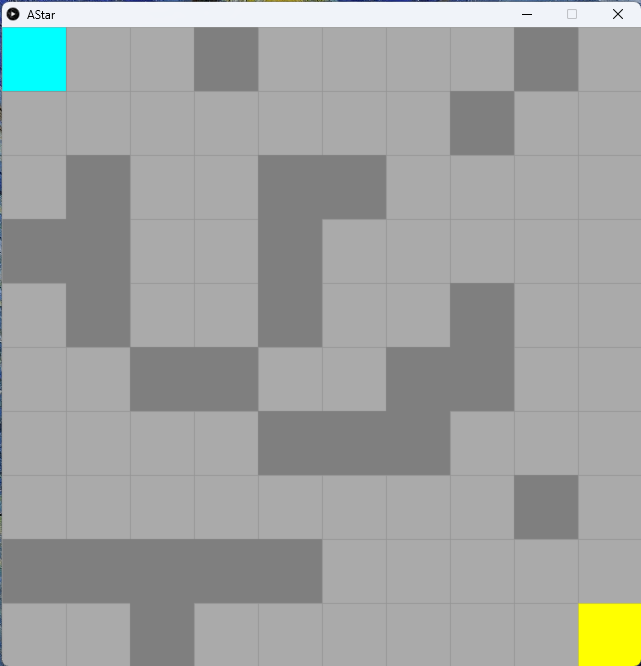
因為前一章已經做過一個差不多一模一樣的介面和程序,這裡就不一一講解了,有興趣或問題可以看上一章。
2. 準備好每個spot的cost和顯示介面
# A demo of the A* pathfinding algorithm.
cols = rows = 10
spots = []
start = end = None
openSet = []
closeSet = []

def setup():
    global start, end, spots, openSet, closeSet
    size(800, 800)
    rectMode(CENTER)
    textAlign(CENTER, CENTER)

    spots = [[Spot(i, j) for j in range(cols)] for i in range(rows)]

    start = spots[0][0]
    end = spots[cols-1][rows-1]

    for i in range(rows):
        for j in range(cols):
            spots[i][j].addWall()

    for i in range(rows):
        for j in range(cols):
            spots[i][j].addNeighbors(spots)

    openSet = [start]
    closeSet = []
    start.gCost = 0


def draw():
    background(0)
    for i in range(rows):
        for j in range(cols):
            spots[i][j].show('#AAAAAA')

    start.show('#00FFFF')
    end.show('#FFFF00')

class Spot:

    def __init__(self, _i, _j):
        self.w = width/cols
        self.h = height/rows
        self.i = _i
        self.j = _j
        self.x = self.i * self.w + self.w/2
        self.y = self.j * self.h + self.h/2
        self.wall = False
        self.neighbors = []
        self.gCost = float('inf')
        self.hCost = 0
        self.fCost = 0
        self.previous = None

    def show(self, _color):
        fill(_color)
        if self.wall:
            fill(127)
        stroke(127)
        strokeWeight(0.5)
        rect(self.x, self.y, self.w, self.h)
        if self in openSet or self in closeSet:
            fill(0)
            noStroke()
            textSize(12)
            text("G:" + str(self.gCost), self.x - self.w/3, self.y-self.h/3)
            text("H:" + str(self.hCost), self.x + self.w/3, self.y-self.h/3)
            textSize(18)
            text("F:" + str(self.fCost), self.x, self.y+self.h/3)

    def addWall(self):
        if self != start and self != end:
            self.wall = True if random(1) < 0.25 else False

    def addNeighbors(self, _spots):
        i = self.i
        j = self.j
        if i < cols - 1 and not _spots[i+1][j].wall:
            self.neighbors.append(_spots[i+1][j])
        if i > 0 and not _spots[i-1][j].wall:
            self.neighbors.append(_spots[i-1][j])
        if j < rows - 1 and not _spots[i][j+1].wall:
            self.neighbors.append(_spots[i][j+1])
        if j > 0 and not _spots[i][j-1].wall:
            self.neighbors.append(_spots[i][j-1])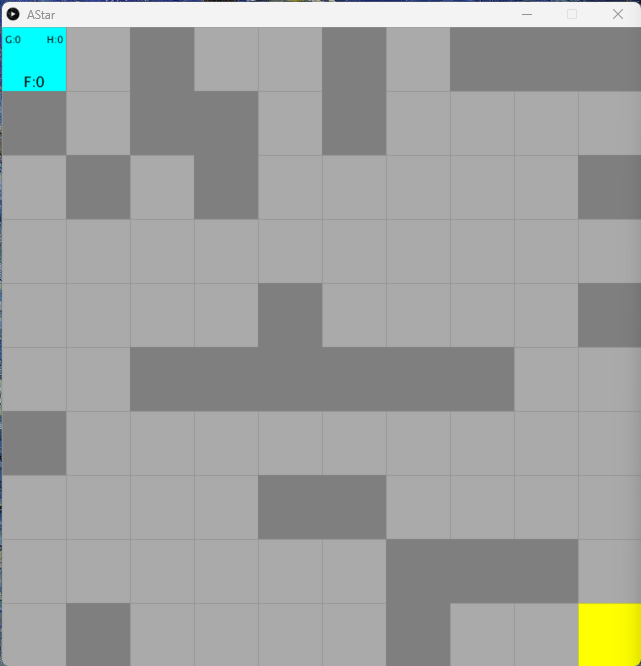
A* 演算法,每個節點(或網格)的計分方法,都是由兩個cost去組成,gCost是指由目標(goal)到現在這一格的距離,而hCost是指由起始點到這一格共行了多少距離。最後這兩個cost相加就叫做fCost,這個cost就是我們想要的分數。
class Spot:

    def __init__(self, _i, _j):
        #(same as before)
        self.gCost = float('inf')
        self.hCost = 0
        self.fCost = 0
self.previous = None首先在Spot class,加入上文所說的cost。
# A demo of the A* pathfinding algorithm.
cols = rows = 10
spots = []
start = end = None
openSet = []
closeSet = []接著在最上方加入openSet = []和closeSet = []。A* 演算法會有一個叫openSet用來紀錄待計算的格,有點像上一章的等候列,另外經過計算的格會由openSet落入closeSet中不會再重覆計算。這部分下一節會詳談和實現。
def setup():
    global start, end, spots, openSet, closeSet

    #(same as before)
    openSet = [start]
    closeSet = []
start.gCost = 0接著在setup()的最後,開始演算法前第一步是將start放入openSet和計定start的gCost為0。
一般路徑演算法都是剛好相反,由終點找回起點;為方便解說和理解,這裡改為由起點找到終點。理論上亦會一併計算
hCost和fCost,但不計算也不會影響結果。
class Spot:

    def __init__(self):
        #(same as before)

    def show(self, _color):
        #(same as before)
    	if self in openSet or self in closeSet:
            fill(0)
            noStroke()
            textSize(12)
            text("G:" + str(self.gCost), self.x - self.w/3, self.y-self.h/3)
            text("H:" + str(self.hCost), self.x + self.w/3, self.y-self.h/3)
            textSize(18)
text("F:" + str(self.fCost), self.x, self.y+self.h/3)最後返回Spot class,將三個相關的cost都顯示出來。
3. 更新每一個格的cost
# A demo of the A* pathfinding algorithm.
cols = rows = 10
spots = []
start = end = None
openSet = []
closeSet = []

def setup():
    global start, end, spots, openSet, closeSet
    size(800, 800)
    rectMode(CENTER)
    textAlign(CENTER, CENTER)
    frameRate(1)

    spots = [[Spot(i, j) for j in range(cols)] for i in range(rows)]

    start = spots[0][0]
    end = spots[cols-1][rows-1]

    for i in range(rows):
        for j in range(cols):
            spots[i][j].addWall()

    for i in range(rows):
        for j in range(cols):
            spots[i][j].addNeighbors(spots)

    openSet = [start]
    closeSet = []
    start.gCost = 0


def draw():
    background(0)

    # find the lowest index of openset
    lowestIndex = 0
    for i in range(len(openSet)):
        if openSet[i].fCost < openSet[lowestIndex].fCost:
            lowestIndex = i

    current = openSet[lowestIndex]

    # update the current spot
    # 1. remove it from openSet
    # 2. add it to closeSet
    # 3. find its neighbors
    # 4. calculate the gCost, hCost, fCost
    # 5. update the previous spot
    # 6. add it to openSet
    openSet.remove(current)
    closeSet.append(current)
    for neighbor in current.neighbors:
        if neighbor not in closeSet and not neighbor.wall:
            tempGCost = current.gCost + 1
            if neighbor in openSet:
                if tempGCost < neighbor.gCost:
                    neighbor.gCost = tempGCost
            else:
                neighbor.gCost = tempGCost
                openSet.append(neighbor)
            neighbor.hCost = walkingDist(neighbor, end)
            neighbor.fCost = neighbor.gCost + neighbor.hCost
            neighbor.previous = current


    for i in range(rows):
        for j in range(cols):
            if spots[i][j] in openSet:
                spots[i][j].show('#99FF99')
            elif spots[i][j] in closeSet:
                spots[i][j].show('#FF9999')
            else:
                spots[i][j].show('#AAAAAA')

    start.show('#00FFFF')
    end.show('#FFFF00')

def walkingDist(_spot1, _spot2):
    return abs(_spot1.i - _spot2.i) + abs(_spot1.j - _spot2.j)

class Spot:

    def __init__(self, _i, _j):
        self.w = width/cols
        self.h = height/rows
        self.i = _i
        self.j = _j
        self.x = self.i * self.w + self.w/2
        self.y = self.j * self.h + self.h/2
        self.wall = False
        self.neighbors = []
        self.gCost = float('inf')
        self.hCost = 0
        self.fCost = 0
        self.previous = None

    def show(self, _color):
        fill(_color)
        if self.wall:
            fill(127)
        stroke(127)
        strokeWeight(0.5)
        rect(self.x, self.y, self.w, self.h)
        if self in openSet or self in closeSet:
            fill(0)
            noStroke()
            textSize(12)
            text("G:" + str(self.gCost), self.x - self.w/3, self.y-self.h/3)
            text("H:" + str(self.hCost), self.x + self.w/3, self.y-self.h/3)
            textSize(18)
            text("F:" + str(self.fCost), self.x, self.y+self.h/3)

    def addWall(self):
        if self != start and self != end:
            self.wall = True if random(1) < 0.25 else False

    def addNeighbors(self, _spots):
        i = self.i
        j = self.j
        if i < cols - 1 and not _spots[i+1][j].wall:
            self.neighbors.append(_spots[i+1][j])
        if i > 0 and not _spots[i-1][j].wall:
            self.neighbors.append(_spots[i-1][j])
        if j < rows - 1 and not _spots[i][j+1].wall:
            self.neighbors.append(_spots[i][j+1])
        if j > 0 and not _spots[i][j-1].wall:
            self.neighbors.append(_spots[i][j-1])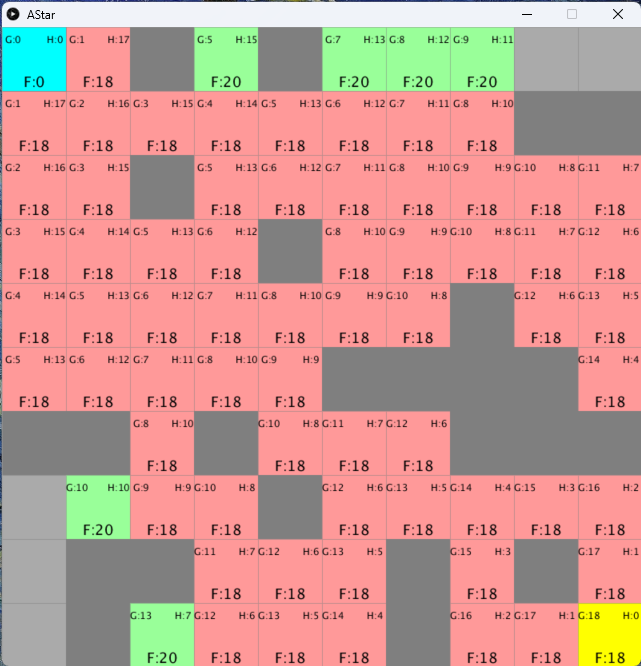
def draw():
    background(0)

    # find the lowest index of openset
    lowestIndex = 0
    for i in range(len(openSet)):
        if openSet[i].fCost < openSet[lowestIndex].fCost:
            lowestIndex = i

    current = openSet[lowestIndex]

    # update the current spot
    # 1. remove it from openSet
    # 2. add it to closeSet
    # 3. find its neighbors
    # 4. calculate the gCost, hCost, fCost
    # 5. update the previous spot
    # 6. add it to openSet
    openSet.remove(current)
    closeSet.append(current)
    for neighbor in current.neighbors:
        if neighbor not in closeSet and not neighbor.wall:
            tempGCost = current.gCost + 1
            if neighbor in openSet:
                if tempGCost < neighbor.gCost:
                    neighbor.gCost = tempGCost
            else:
                neighbor.gCost = tempGCost
                openSet.append(neighbor)
            neighbor.hCost = walkingDist(neighbor, end)
            neighbor.fCost = neighbor.gCost + neighbor.hCost
neighbor.previous = currentA* 演算法會有一個openSet和closeSet,第一步是將起點加入到openSet,之後的每一步,
- 首先要找到全部
openSet中,分數(fCost)最低的格,設定這一格做current - 將這一格
current移出openSet - 將這一格
current移入closeSet - 找出這一格
current的所有neighbors4. 計算基於current鄰居的gCost5. 如果鄰居本身就是openSet,就對比基於current鄰居計算的gCost是否少於它的gCost6. 如果是不在openSet的新一格,就更新它的gCost7. 計算每個鄰居的hCost和fCost8. 更新這個鄰居是從哪裡來
def draw():
    #(same as before)
    for i in range(rows):
        for j in range(cols):
            if spots[i][j] in openSet:
                spots[i][j].show('#99FF99')
            elif spots[i][j] in closeSet:
                spots[i][j].show('#FF9999')
            else:
                spots[i][j].show('#AAAAAA')

    start.show('#00FFFF')
end.show('#FFFF00')之後就為openSet和closeSet加入不同的顏色方便觀察。
def walkingDist(_spot1, _spot2):
return abs(_spot1.i - _spot2.i) + abs(_spot1.j - _spot2.j)最後就是加入計算hCost的函數。gCost是一路走出累加了多少步,需要考慮中途遇到的障礙物,而 hCost是預估到終點還有多少步,這個預估是不需要理會障礙物的,就當是完全沒有障礙物,只計算步數。由於我們的計算是只有上、下、左和右,沒有打斜走的,所以由一格到另一格要走的最短路程,就是兩格的i的差和j的差之和。
4. 加入如果沒有答案或已找到路徑
# A demo of the A* pathfinding algorithm.
cols = rows = 10
spots = []
start = end = None
openSet = []
closeSet = []
path = []

def setup():
    global start, end, spots, openSet, closeSet
    size(800, 800)
    rectMode(CENTER)
    textAlign(CENTER, CENTER)
    frameRate(10)

    spots = [[Spot(i, j) for j in range(cols)] for i in range(rows)]

    start = spots[0][0]
    end = spots[cols-1][rows-1]

    for i in range(rows):
        for j in range(cols):
            spots[i][j].addWall()

    for i in range(rows):
        for j in range(cols):
            spots[i][j].addNeighbors(spots)

    openSet = [start]
    closeSet = []
    start.gCost = 0


def draw():
    global path
    background(0)

    # if openSet is empty, then no solution
    if len(openSet) == 0:
        print("no solution")
        noLoop()
        return

    # find the lowest index of openset
    lowestIndex = 0
    for i in range(len(openSet)):
        if openSet[i].fCost < openSet[lowestIndex].fCost:
            lowestIndex = i

    current = openSet[lowestIndex]

    # if current is the end, then find the path
    if current == end:
        print("find the path")
        path = [current]
        temp = current
        while temp.previous: # only the start has no previous
            path.append(temp.previous)
            temp = temp.previous
        print("path is found!")
        noLoop()

    # update the current spot
    # 1. remove it from openSet
    # 2. add it to closeSet
    # 3. find its neighbors
    # 4. calculate the gCost, hCost, fCost
    # 5. update the previous spot
    # 6. add it to openSet
    openSet.remove(current)
    closeSet.append(current)
    for neighbor in current.neighbors:
        if neighbor not in closeSet and not neighbor.wall:
            tempGCost = current.gCost + 1
            if neighbor in openSet:
                if tempGCost < neighbor.gCost:
                    neighbor.gCost = tempGCost
            else:
                neighbor.gCost = tempGCost
                openSet.append(neighbor)
            neighbor.hCost = walkingDist(neighbor, end)
            neighbor.fCost = neighbor.gCost + neighbor.hCost
            neighbor.previous = current


    for i in range(rows):
        for j in range(cols):
            if spots[i][j] in openSet:
                spots[i][j].show('#99FF99')
            elif spots[i][j] in closeSet:
                spots[i][j].show('#FF9999')
            else:
                spots[i][j].show('#AAAAAA')

    # draw the path
        for p in path:
            p.show('#9999FF')

    start.show('#00FFFF')
    end.show('#FFFF00')

def walkingDist(_spot1, _spot2):
    return abs(_spot1.i - _spot2.i) + abs(_spot1.j - _spot2.j)

class Spot:

    def __init__(self, _i, _j):
        self.w = width/cols
        self.h = height/rows
        self.i = _i
        self.j = _j
        self.x = self.i * self.w + self.w/2
        self.y = self.j * self.h + self.h/2
        self.wall = False
        self.neighbors = []
        self.gCost = float('inf')
        self.hCost = 0
        self.fCost = 0
        self.previous = None

    def show(self, _color):
        fill(_color)
        if self.wall:
            fill(127)
        stroke(127)
        strokeWeight(0.5)
        rect(self.x, self.y, self.w, self.h)
        if self in openSet or self in closeSet:
            fill(0)
            noStroke()
            textSize(12)
            text("G:" + str(self.gCost), self.x - self.w/3, self.y-self.h/3)
            text("H:" + str(self.hCost), self.x + self.w/3, self.y-self.h/3)
            textSize(18)
            text("F:" + str(self.fCost), self.x, self.y+self.h/3)

    def addWall(self):
        if self != start and self != end:
            self.wall = True if random(1) < 0.25 else False

    def addNeighbors(self, _spots):
        i = self.i
        j = self.j
        if i < cols - 1 and not _spots[i+1][j].wall:
            self.neighbors.append(_spots[i+1][j])
        if i > 0 and not _spots[i-1][j].wall:
            self.neighbors.append(_spots[i-1][j])
        if j < rows - 1 and not _spots[i][j+1].wall:
            self.neighbors.append(_spots[i][j+1])
        if j > 0 and not _spots[i][j-1].wall:
            self.neighbors.append(_spots[i][j-1])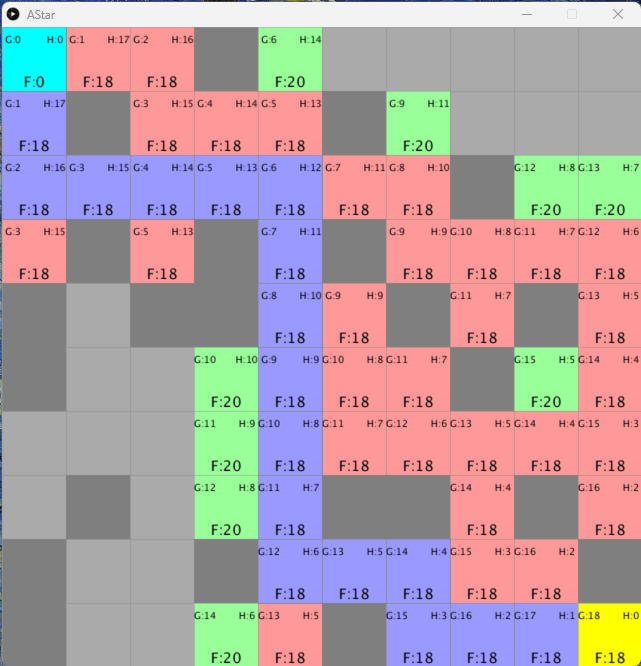
 # if openSet is empty, then no solution
    if len(openSet) == 0:
        print("no solution")
noLoop()加入兩個考量,如果openSet是空的話,而又有未答案的話,即沒有答案。
 # if current is the end, then find the path
    if current == end:
        print("find the path")
        path = [current]
        temp = current
        while temp.previous: # only the start has no previous
            path.append(temp.previous)
            temp = temp.previous
        print("path is found!")
noLoop()如果找到end的話,即找到答案。如果目前所處的位置是終點,就找到了一條路徑。當找到路徑後,程式會列印出「找到路徑」的訊息,並建立一個包含當前位置的列表,接著使用一個暫存變數來追蹤前一個位置,並將前一個位置加入到路徑列表中。直到追蹤到起點,也就是前一個位置沒有「previous」屬性時,迴圈才會停止。最後,程式會列印出「已找到路徑!」的訊息,並退出所有迴圈。
考考你
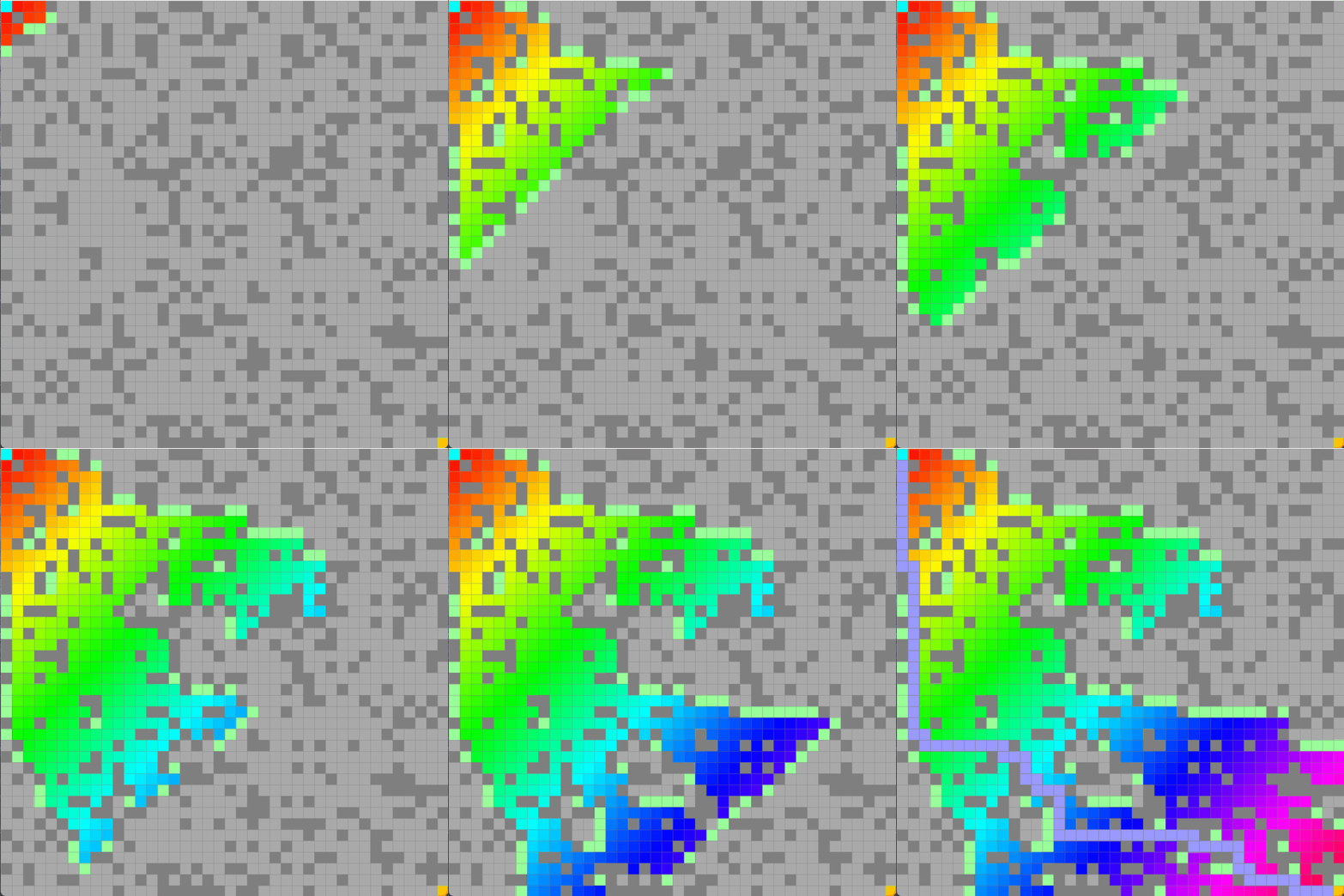
試著將程式美化到我這個效果,我是將所有closeSet的顏色,用map將其變成color(map(spots[i][j].gCost, 0, cols + rows, 0, 255),記得要在setup將顏色先設定成colorMode(HSB, 255)