Minimax 演算法
[toc]
0. recursion 遞歸
Fibonacci sequence(費波那契數)是一個常見用來解釋recursion遞歸概念的數列。定義上,
用文字來說,就是斐波那契數列由0和1開始,之後的費波那契數就是由之前的兩數相加而得出。首幾個費波那契數是:
1、 1、 2、 3、 5、 8、 13、 21、 34、 55、 89、 144、 233、 377、 610、 987……
def setup():
    for i in range(1,10):
        print(Fibonacci(i))
    exit()

def Fibonacci(n):
    if n == 0:
        return 0
    if n == 1:
        return 1
    if n >=2:
return Fibonacci(n-1)+Fibonacci(n-2)得出結果:
1
1
2
3
5
8
13
21
34這個在函數之中call自己的方法叫做遞歸recursion,遞歸在程式中非常常用,但不一定時好方法。
以上述的斐波那契數列為例,
def setup():
    timer = millis()
    print(Fibonacci(10))
    print(millis()-timer)
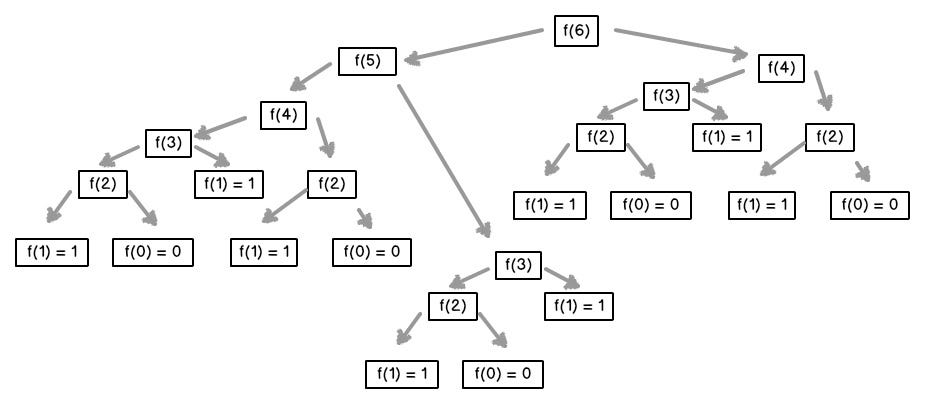
exit()計算只需要4毫秒,但計算,時間不是其2倍的8毫秒,而是51毫秒。這是因為,要計算,就要先計算和,要計算和,又要先計算,和,如此類推,其實有很多重覆了的計算,會令程式以幾何級的時間遞增。
1. 為遊戲加入打和
connectFour_AI.pyde:
from spot import *
from gameBoard import *

gameBoard = 0

def setup():
    global grids, gameBoard

    size(700, 600)
    ellipseMode(CENTER)
    frameRate(10)
    gameBoard = GameBoard()

def draw():
    background(200)
    gameBoard.display()

def mousePressed():
    global gameBoard
    for i in range(7):
        if (mouseX > width/7*i and mouseX < width/7*(i+1)):
gameBoard.trigger(i)gameBoard.py:
from spot import *

class GameBoard(object):

    def __init__(self):
        self.grids = []
        for i in range(6):
            temp = []
            for j in range(7):
                temp.append(Spot(i, j, width/7*(j+.5), height/6*(i+.5), ''))
            self.grids.append(temp)
        self.currentRow = 0
        self.currentCol = 0
        self.colHeight = [0, 0, 0, 0, 0, 0, 0]
        self.currentPlayer = 'R'
        self.gameOver = False
        self.winner = None

    def display(self):
        for i in range(6):
                for j in range(7):
                    self.grids[i][j].display()
        if self.gameOver == True:
            textAlign(CENTER, CENTER)
            textSize(100)
            fill('#0000FF')
            if self.winner == 'R':
                text('YOU WIN!!!!', width/2, height/2)
            elif self.winner == 'Y':
                text('GAME OVER', width/2, height/2)
            elif self.winner == 'O':
                text('TIE', width/2, height/2)

    def swapPlayer(self):
        if self.currentPlayer == 'R':
            self.currentPlayer = 'Y'
        elif self.currentPlayer == 'Y':
            self.currentPlayer = 'R'

    def trigger(self, i):
        if self.gameOver == False:
            if self.colHeight[i] < 6:
                self.colHeight[i] += 1
                self.currentCol = i
                self.currentRow = 6 - self.colHeight[i]
                self.grids[self.currentRow][self.currentCol].value = self.currentPlayer
                self.winner = self.checkWin()
                if self.winner != None:
                    self.gameOver = True
                    return
                self.swapPlayer()

    def checkWin(self):
        gs = self.grids

        # check horizontal
        for i in range(6):
            for j in range(4):
                if gs[i][j].value == gs[i][j+1].value == gs[i][j+2].value == gs[i][j+3].value\
                        and gs[i][j].value != '':
                    return gs[i][j].value

        # check vertical
        for i in range(3):
            for j in range(7):
                if gs[i][j].value == gs[i+1][j].value == gs[i+2][j].value == gs[i+3][j].value\
                        and gs[i][j].value != '':
                    return gs[i][j].value

        # check right cross
        for i in range(3):
            for j in range(4):
                if gs[i][j].value == gs[i+1][j+1].value == gs[i+2][j+2].value == gs[i+3][j+3].value\
                        and gs[i][j].value != '':
                    return gs[i][j].value

        # check left cross
        for i in range(3):
            for j in range(3, 7):
                if gs[i][j].value == gs[i+1][j-1].value == gs[i+2][j-2].value == gs[i+3][j-3].value\
                        and gs[i][j].value != '':
                    return gs[i][j].value

        # if all the grids are filled, the game is tie
        isAllNull = False
        for i in range(6):
            for j in range(7):
                isAllNull = isAllNull or gs[i][j].value == ''
        if isAllNull == False:
return 'O'spot.py:
class Spot(object):
    def __init__(self, _i, _j, _x, _y, _value):
        self.i = _i
        self.j = _j
        self.x = _x
        self.y = _y
        self.value = ''

    def display(self):
        stroke('#000000')
        strokeWeight(2)
        fill(self.matchColor(self.value))
        ellipse(self.x, self.y, 80, 80)

    def matchColor(self, _value):
        if _value == '':
            return '#FFFFFF'
        elif _value == 'R':
            return '#FF5641'
        elif _value == 'Y':
            return '#FFDF37'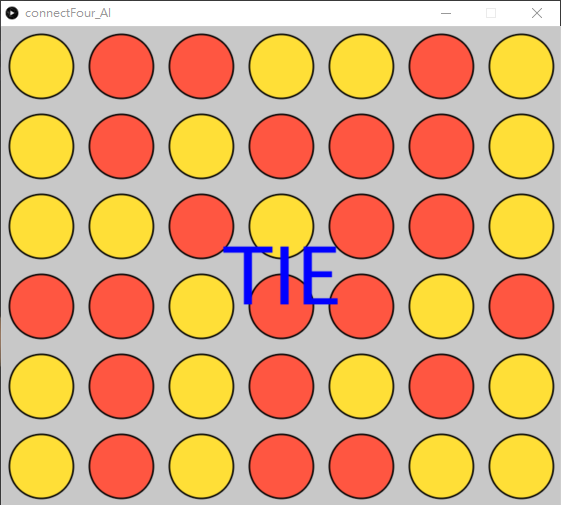
首先在gameBoard.py的class中,
 def checkWin(self):
        gs = self.grids
        #other cods

        # if all the grids are filled, the game is tie
        isAllNull = False
        for i in range(6):
            for j in range(7):
                isAllNull = isAllNull or gs[i][j].value == ''
        if isAllNull == False:
return 'O'在checkWin()的最後加入isAllNull = False,之後對每一個格都做or運算,只要其中一個格是沒有填的話,isAllNull都會變成True,只有在全部都填滿下,isAllNull才會運算完42次後都是False,如果是False的話,即全部格已滿,所以就是打和了。
def display(self):
       #other cods
        if self.winner == 'R':
            text('YOU WIN!!!!', width/2, height/2)
        elif self.winner == 'Y':
            text('GAME OVER', width/2, height/2)
        elif self.winner == 'O':
text('TIE', width/2, height/2)之後同樣是在gameBoard.py中,如果self.winner == 'O',即遊戲打和,則在顯示中加入打和。
2. 加入random AI跟玩家對玩
connectFour_AI.pyde:
from spot import *
from gameBoard import *

gameBoard = 0


def setup():
    global grids, gameBoard

    size(700, 600)
    ellipseMode(CENTER)
    frameRate(10)

    gameBoard = GameBoard()


def draw():
    background(200)
    gameBoard.display()


def mousePressed():
    global gameBoard
    for i in range(7):
        if (mouseX > width/7*i and mouseX < width/7*(i+1)):
            gameBoard.trigger(i)
            if gameBoard.currentPlayer == 'Y':
gameBoard.brain.autoPlay()gameBoard.py
from spot import *
from AIBrain import *

class GameBoard(object):

    def __init__(self):
        self.grids = []
        for i in range(6):
            temp = []
            for j in range(7):
                temp.append(Spot(i, j, width/7*(j+.5), height/6*(i+.5), ''))
            self.grids.append(temp)

        self.currentRow = 0
        self.currentCol = 0
        self.colHeight = [0, 0, 0, 0, 0, 0, 0]
        self.currentPlayer = 'R'
        self.gameOver = False
        self.winner = None
        self.brain = aiBrain(self)

    def display(self):
        for i in range(6):
                for j in range(7):
                    self.grids[i][j].display()
        if self.gameOver == True:
            textAlign(CENTER, CENTER)
            textSize(100)
            fill('#0000FF')
            if self.winner == 'R':
                text('YOU WIN!!!!', width/2, height/2)
            elif self.winner == 'Y':
                text('GAME OVER', width/2, height/2)
            elif self.winner == 'O':
                text('TIE', width/2, height/2)


    def swapPlayer(self):
        if self.currentPlayer == 'R':
            self.currentPlayer = 'Y'
        elif self.currentPlayer == 'Y':
            self.currentPlayer = 'R'

    def trigger(self, i):
        if self.gameOver == False:
            if self.colHeight[i] < 6:
                self.colHeight[i] += 1
                self.currentCol = i
                self.currentRow = 6 - self.colHeight[i]
                self.grids[self.currentRow][self.currentCol].value = self.currentPlayer
                self.winner = self.checkWin()
                if self.winner != None:
                    self.gameOver = True
                    return
                self.swapPlayer()


    def checkWin(self):
        gs = self.grids

        # check horizontal
        for i in range(6):
            for j in range(4):
                if gs[i][j].value == gs[i][j+1].value == gs[i][j+2].value == gs[i][j+3].value\
                        and gs[i][j].value != '':
                    return gs[i][j].value

        # check vertical
        for i in range(3):
            for j in range(7):
                if gs[i][j].value == gs[i+1][j].value == gs[i+2][j].value == gs[i+3][j].value\
                        and gs[i][j].value != '':
                    return gs[i][j].value

        # check right cross
        for i in range(3):
            for j in range(4):
                if gs[i][j].value == gs[i+1][j+1].value == gs[i+2][j+2].value == gs[i+3][j+3].value\
                        and gs[i][j].value != '':
                    return gs[i][j].value

        # check left cross
        for i in range(3):
            for j in range(3, 7):
                if gs[i][j].value == gs[i+1][j-1].value == gs[i+2][j-2].value == gs[i+3][j-3].value\
                        and gs[i][j].value != '':
                    return gs[i][j].value

        # if all the grids are filled, the game is tie
        isAllNull = False
        for i in range(6):
            for j in range(7):
                isAllNull = isAllNull or gs[i][j].value == ''
        if isAllNull == False:
return 'O'AIBrain.py:
import copy
import random


class aiBrain(object):

    def __init__(self, _gameBoard):
        self.gameBoard = _gameBoard

    def autoPlay(self):
        bestScore = float('-inf')

        # fill the available colume to an list
        availableCol = []
        for j in range(7):
            if self.gameBoard.grids[0][j].value == '':
                availableCol.append(j)
        # shuffle the list
        random.shuffle(availableCol)

        for move in availableCol:
            score = self.minimax(self.gameBoard, 4, False)
            if (score > bestScore):
                bestScore = score
                bestMove = move
        self.gameBoard.trigger(bestMove)

    def minimax(self, _gameBoard, _depth, _isMaximizing):
        return 1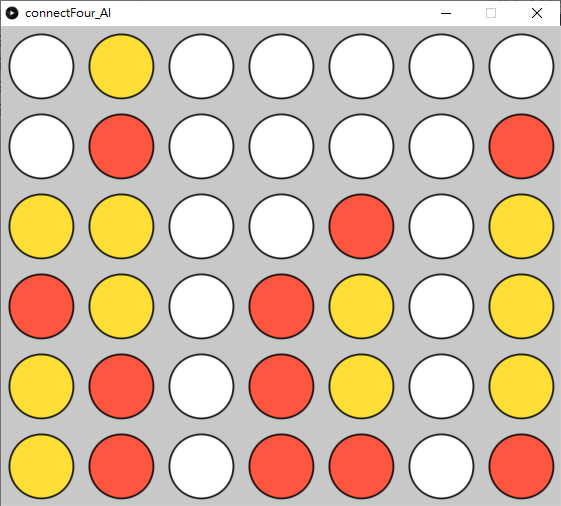
加入一個叫AIBrain.py的檔案,這個檔案一開始先做一點簡單的測試。在初始化時,匯入現有的gameBoard
class aiBrain(object):

    def __init__(self, _gameBoard):
self.gameBoard = _gameBoard之後,
 def autoPlay(self):
        bestScore = float('-inf')

        # //fill the available colume to an list
        availableCol = []
        for j in range(7):
            if self.gameBoard.grids[0][j].value == '':
                availableCol.append(j)
        # shuffle the list
        random.shuffle(availableCol)

        for move in availableCol:
            score = self.minimax(self.gameBoard, 4, False)
            if (score > bestScore):
                bestScore = score
                bestMove = move
        self.gameBoard.trigger(bestMove)

    def minimax(self, _gameBoard, _depth, _isMaximizing):
return 1我們要為下一步所有可能的步數去計分,才知那一個才對AI方最有利。
我們設定玩家方為正分,AI方為負分數,所以每一步越是負得多,即對AI方是最有利的。
一開始設定bestScore = float('-inf'),就是負無限大。
將一個叫availableCol = []去裝起所有可能的下一步,這7個欄之中,如果if self.gameBoard.grids[0][j].value == '':即最上一格為空,即可以填入,所以就將其append到availableCol。
下一步是shuffle即調亂整個列,如果分數是相同的話,則最後結果會有亂數,不會每次都是由左至右。
之後每一個可能的落祺步,都加入一個叫minimax()的演算法去幫這一步計分,分數最大的步就是最佳答案,於是我們便落子這一步。但現階段我們的minimax()演算法暫時甚麼都沒有,全部回傳的分數都是1,我們先試一試這個思路是否行得通。
3. 加入dummy AI
AIBrain.py:
import copy
import random


class aiBrain(object):

    def __init__(self, _gameBoard):
        self.gameBoard = _gameBoard

    def autoPlay(self):
        bestScore = float('-inf')
        bestMove = random.randint(0, 5)  # the range is a, b+1

        # //fill the available colume to an list
        availableCol = []
        for j in range(7):
            if self.gameBoard.grids[0][j].value == '':
                availableCol.append(j)
        # shuffle the list
        random.shuffle(availableCol)

        for move in availableCol:
            possibleBoard = copy.deepcopy(self.gameBoard)
            possibleBoard.trigger(move)
            score = self.minimax(possibleBoard, 4, False)
            print(move, score)
            if (score > bestScore):
                bestScore = score
                bestMove = move
            print(bestMove)
        print('')
        self.gameBoard.trigger(bestMove)

    def score(self, _winner):
        if _winner == 'R':
            return 10
        elif _winner == 'Y':
            return -10
        elif _winner == 'O':
            return 0

    def minimax(self, _gameBoard, _depth, _isMaximizing):
        winner = _gameBoard.checkWin()
        if winner != None:
            return self.score(winner)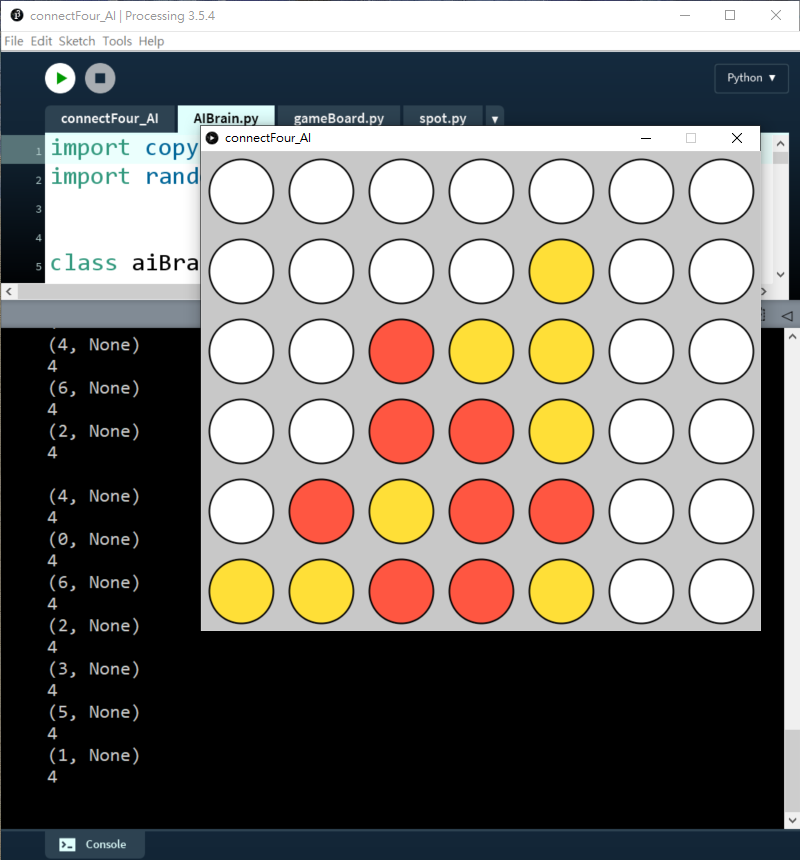
在AIBrain.py中,
    for move in availableCol:
        possibleBoard = copy.deepcopy(self.gameBoard)
        possibleBoard.trigger(move)
        score = self.minimax(possibleBoard, 4, False)
        print(move, score)
        if (score > bestScore):
            bestScore = score
            bestMove = move
        print(bestMove)
    print('')
self.gameBoard.trigger(bestMove)我們用copy.deepcopy()去將整個gameboard複製。Python和其他高級語言一樣,如果只用=去複製一個class的話,只會複製其id,之後修改這個class的話,被複製的和複製後的class都會改變,所以要用copy.deepcopy()去將整個gameboard完全複製。
之後就將當前這一步落子到複製出來的possibleBoard,接著就將這個gameboard放到minimax演算法中提出最佳答案。
    def minimax(self, _gameBoard, _depth, _isMaximizing):
        winner = _gameBoard.checkWin()
        if winner != None:
return self.score(winner)上一步我們的minimax演算法只會回傳1分出來,甚麼功能也沒有的。這一步我們幫輸入的gameboard檢查一下有否贏、輸或打和,分別根據這3個情況打分如下:
    def score(self, _winner):
        if _winner == 'R':
            return 10
        elif _winner == 'Y':
            return -10
        elif _winner == 'O':
return 0贏出的話就打10分,輸就是-10分,打和就是0分。
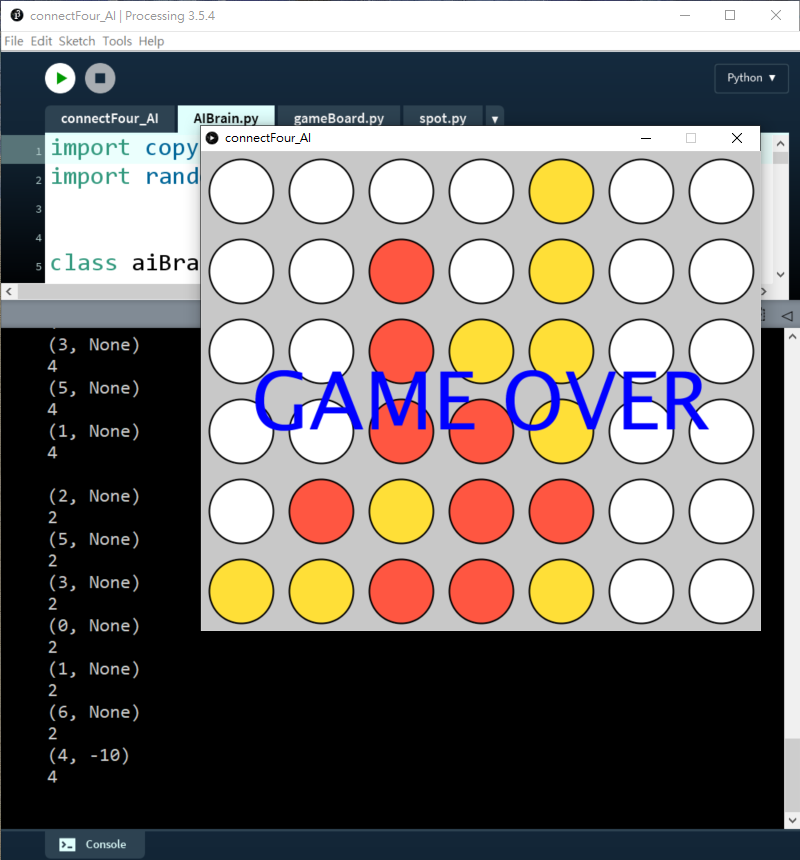
由於設定了bestScore最開始時是負無限大,所以即使AI(黃色棋子)輸出的話是-10分,也依然大於負無限大,所以這個dummy AI都會落子,但只限於此。這個AI唯一的功能是如果下一步AI會贏,而玩家又沒有阻擋的話,AI就會懂得落子去贏出遊戲,但這個AI既不懂阻擋玩家,更不會佈局的。
4. 加入minimax演算法
import copy
import random


class aiBrain(object):

    def __init__(self, _gameBoard):
        self.gameBoard = _gameBoard

    def autoPlay(self):
        bestScore = float('-inf')
        bestMove = random.randint(0, 5)  # the range is a, b+1

        # //fill the available colume to an list
        availableCol = []
        for j in range(7):
            if self.gameBoard.grids[0][j].value == '':
                availableCol.append(j)
        # shuffle the list
        random.shuffle(availableCol)

        for move in availableCol:
            possibleBoard = copy.deepcopy(self.gameBoard)
            possibleBoard.trigger(move)
            score = self.minimax(possibleBoard, 1, False)
            print(move, score)
            if (score > bestScore):
                bestScore = score
                bestMove = move
            print(bestMove)
        print('')
        self.gameBoard.trigger(bestMove)

    def score(self, _winner):
        if _winner == 'R':
            return 10
        elif _winner == 'Y':
            return -10
        elif _winner == 'O':
            return 0

    def minimax(self, _gameBoard, _depth, _isMaximizing):
        winner = _gameBoard.checkWin()
        if winner != None or _depth == 0:
            return self.score(winner)

        if _isMaximizing:
            bestScore = float('-inf')
            # //fill the available colume to an list
            availableCol = []
            for j in range(7):
                if _gameBoard.grids[0][j].value == '':
                    availableCol.append(j)
            # shuffle the list
            random.shuffle(availableCol)

            for move in availableCol:
                possibleBoard = copy.deepcopy(_gameBoard)
                possibleBoard.trigger(move)
                score = self.minimax(possibleBoard, _depth - 1, False)
                bestScore = max(score, bestScore)
            return bestScore

        else:
            bestScore = float('inf')
            # //fill the available colume to an list
            availableCol = []
            for j in range(7):
                if _gameBoard.grids[0][j].value == '':
                    availableCol.append(j)
            # shuffle the list
            random.shuffle(availableCol)

            for move in availableCol:
                possibleBoard = copy.deepcopy(_gameBoard)
                possibleBoard.trigger(move)
                score = self.minimax(possibleBoard, _depth - 1, True)
                bestScore = min(score, bestScore)
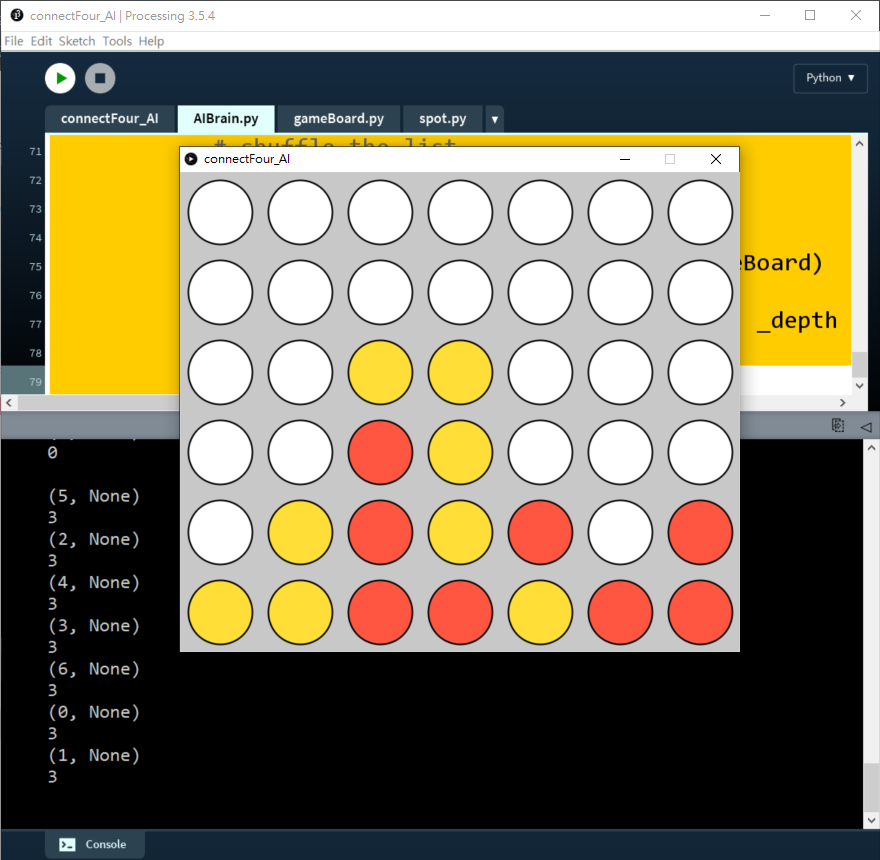
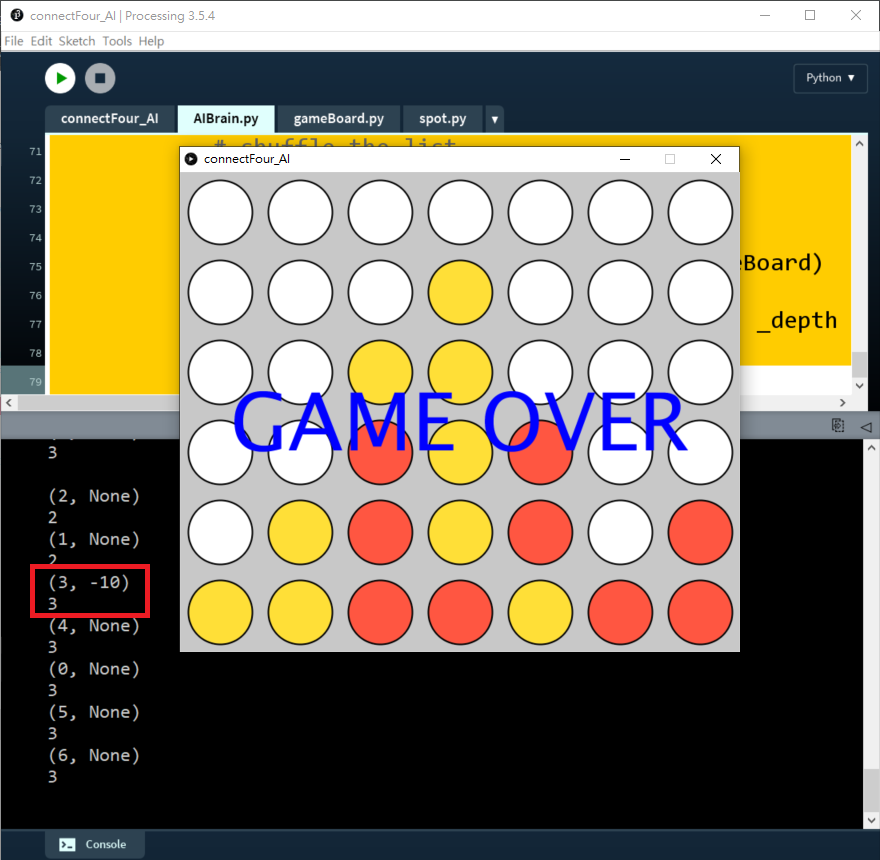
return bestScore測試depth = 1:
測試depth = 2:
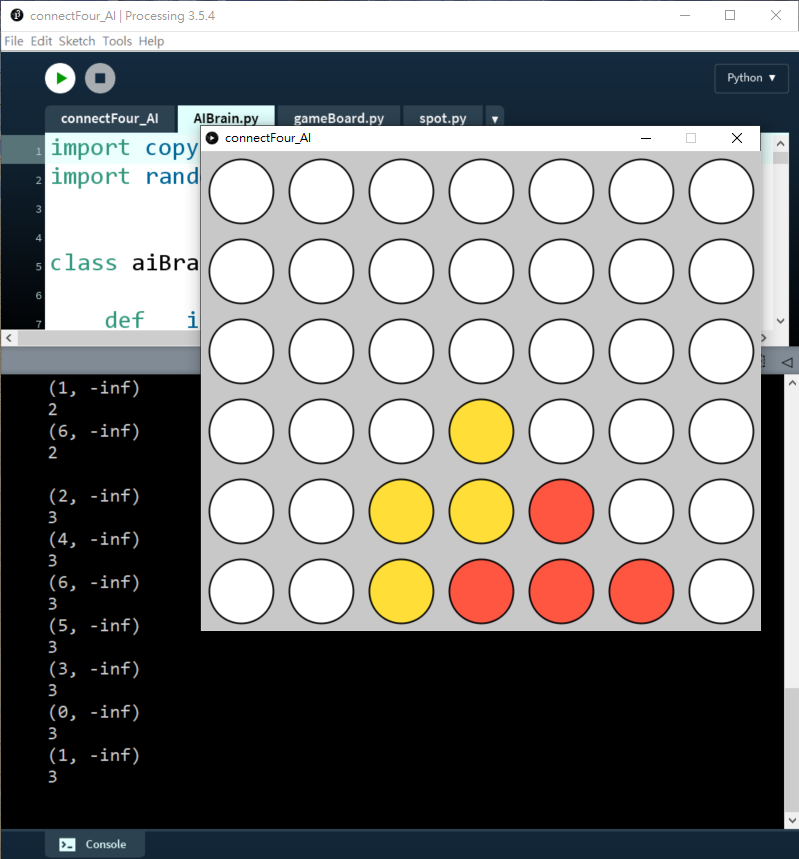
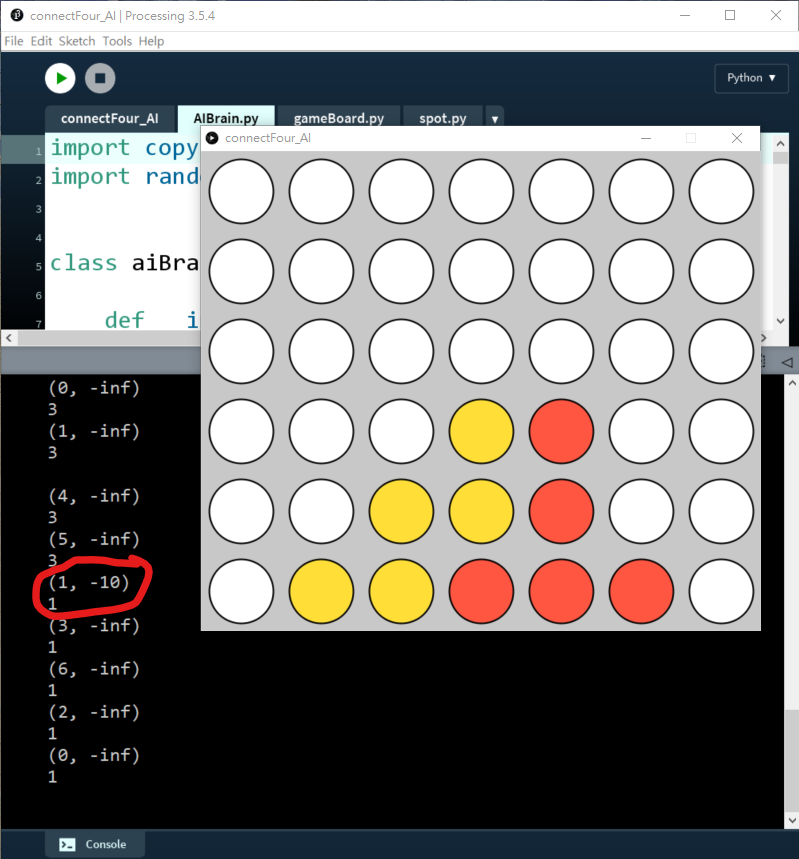
效果:即使depth再增加,AI都只會懂得幫自己提早抬轎,而不懂阻擋我。
 def minimax(self, _gameBoard, _depth, _isMaximizing):
        winner = _gameBoard.checkWin()
        if winner != None or _depth == 0:
            return self.score(winner)

        if _isMaximizing:
            bestScore = float('-inf')
            # //fill the available colume to an list
            availableCol = []
            for j in range(7):
                if _gameBoard.grids[0][j].value == '':
                    availableCol.append(j)
            # shuffle the list
            random.shuffle(availableCol)

            for move in availableCol:
                possibleBoard = copy.deepcopy(_gameBoard)
                possibleBoard.trigger(move)
                score = self.minimax(possibleBoard, _depth - 1, False)
                bestScore = max(score, bestScore)
            return bestScore

        else:
            bestScore = float('inf')
            # //fill the available colume to an list
            availableCol = []
            for j in range(7):
                if _gameBoard.grids[0][j].value == '':
                    availableCol.append(j)
            # shuffle the list
            random.shuffle(availableCol)

            for move in availableCol:
                possibleBoard = copy.deepcopy(_gameBoard)
                possibleBoard.trigger(move)
                score = self.minimax(possibleBoard, _depth - 1, True)
                bestScore = min(score, bestScore)
return bestScoreMinimax演算法基本上就是將所有可能的落子造成一個tree diagram,而每一層的tree diagram,跟據玩家的交換,一層的分數需要最少化,下一層的分數需要最大化,如此類推,詳細可以看看上面的影片。
 def minimax(self, _gameBoard, _depth, _isMaximizing):
        winner = _gameBoard.checkWin()
        if winner != None or _depth == 0:
return self.score(winner)一開始,跟之前一樣,首先檢查有沒有贏、輸或打和,如果這一落子有的話,就可以即時回傳分數。另一個回傳跳出這個minimax()函數的情況是depth==0到底了,這樣回傳的話由於沒有贏家,會回傳None。
if _isMaximizing:
            bestScore = float('-inf')
            # //fill the available colume to an list
            availableCol = []
            for j in range(7):
                if _gameBoard.grids[0][j].value == '':
                    availableCol.append(j)
            # shuffle the list
            random.shuffle(availableCol)

            for move in availableCol:
                possibleBoard = copy.deepcopy(_gameBoard)
                possibleBoard.trigger(move)
                score = self.minimax(possibleBoard, _depth - 1, False)
                bestScore = max(score, bestScore)
return bestScore之後這一段就跟上面非常相似了,如果是最大化的case,就將bestScore設定成負無限大,接著便deepcopy一個新的gameboard,將所有可能的步都試行一次,比較特別的是,這次 score = self.minimax(possibleBoard, _depth - 1, False)minimax函數我們將函數輸入的_depth減1,函數最後的False是指_isMaximizing,所以如果這次_isMaximizing是True,那下一步就設定成False。
 else:
            bestScore = float('inf')
            # //fill the available colume to an list
            availableCol = []
            for j in range(7):
                if _gameBoard.grids[0][j].value == '':
                    availableCol.append(j)
            # shuffle the list
            random.shuffle(availableCol)

            for move in availableCol:
                possibleBoard = copy.deepcopy(_gameBoard)
                possibleBoard.trigger(move)
                score = self.minimax(possibleBoard, _depth - 1, True)
                bestScore = min(score, bestScore)
return bestScore程式的下半部分基本上同,不同的是一開始的bestScore設定成正無限大,而score = self.minimax(possibleBoard, _depth - 1, True)也將最後的_isMaximizing部分設定成True。
這裡minimax()函數入面包裹著minimax()函數,就是我們上面所說的 recursion 遞歸。雖然不是最快的方法,但在編程上會簡潔很多。
5. 令AI懂得阻擋我方
def autoPlay(self):
    bestScore = float('inf')
    bestMove = random.randint(0, 5)  # the range is a, b+1

    # //fill the available colume to an list
    availableCol = []
    for j in range(7):
        if self.gameBoard.grids[0][j].value == '':
            availableCol.append(j)
    # shuffle the list
    random.shuffle(availableCol)

    for move in availableCol:
        possibleBoard = copy.deepcopy(self.gameBoard)
        possibleBoard.trigger(move)
        score = self.minimax(possibleBoard, 1, True)
        print(move, score)
        if (score < bestScore):
            bestScore = score
            bestMove = move
        print(bestMove)
    print('')
self.gameBoard.trigger(bestMove)當depth = 1:
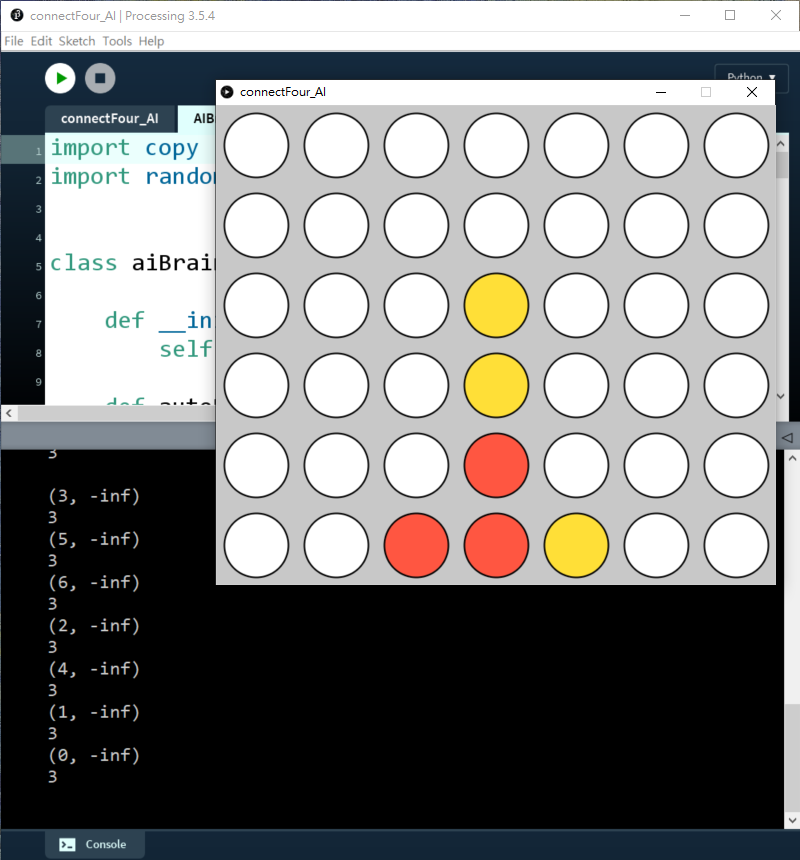
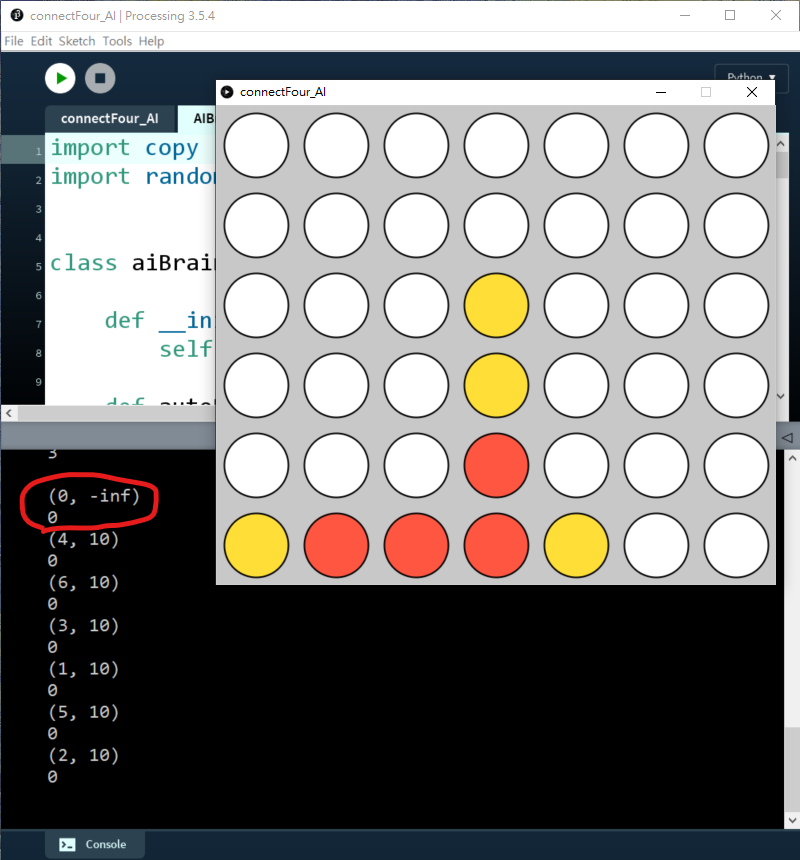
可以見到,如果我落子第2欄(i=1),AI就會知道我下一步會贏,所以要優先落子第1欄)i=0)
如果進一步將depth = 3:
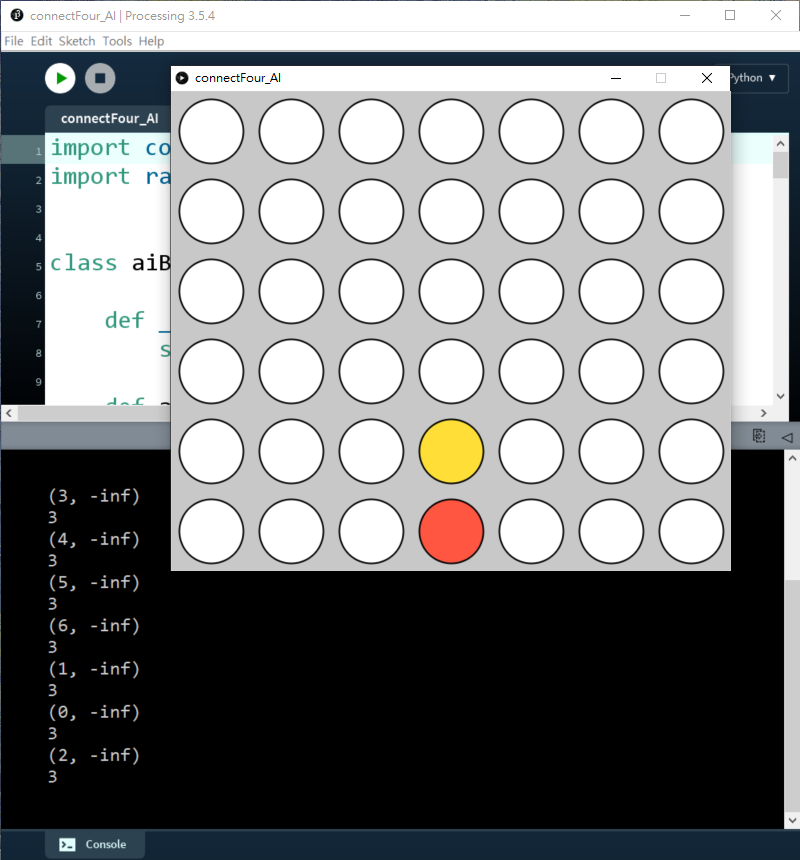
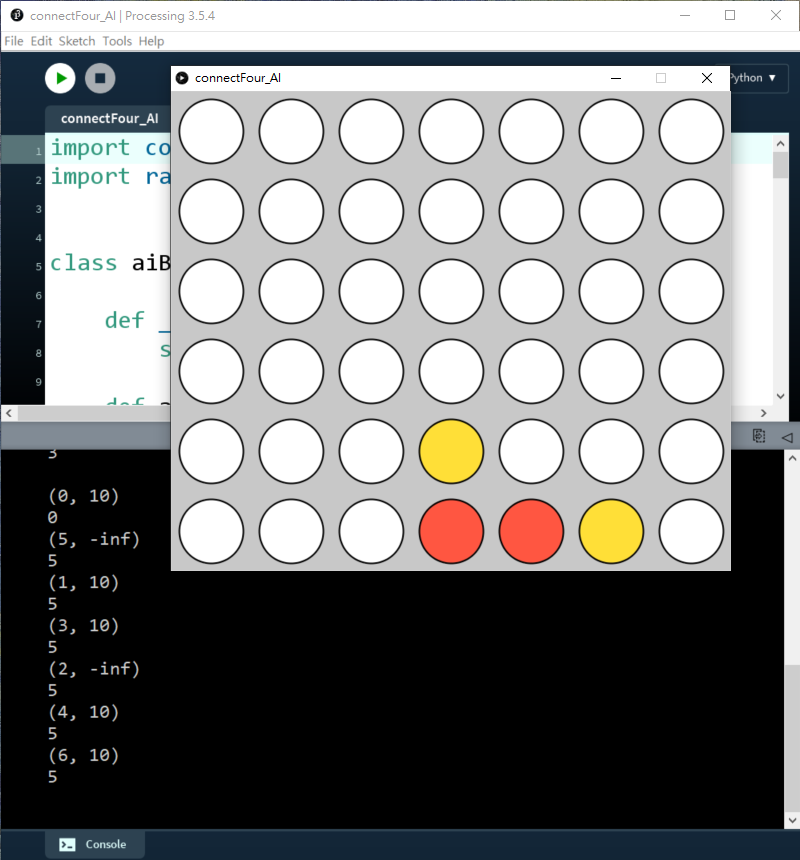
AI甚至懂得防止雙頭蛇,提早在第3欄(i=2)或第6欄(i=6)阻擋我。
上一步的AI之所以不懂阻擋我方,原因是bestScore一開始是設定成負無限大,之後找出最大的bestScore來落子,但我們設定分數時,如果AI方贏的話,分數會是-10分,所以我們找bestScore和bestMove時,找的應該是最小的負數,而不是最大的正數。只要交換,就能正確地令AI懂得防守。
6. 既能阻擋我方,又懂得贏
import copy
import random


class aiBrain(object):

    def __init__(self, _gameBoard):
        self.gameBoard = _gameBoard

    def autoPlay(self):
        bestScore = float('inf')
        bestMove = random.randint(0, 5)  # the range is a, b+1

        # //fill the available colume to an list
        availableCol = []
        for j in range(7):
            if self.gameBoard.grids[0][j].value == '':
                availableCol.append(j)
        # shuffle the list
        random.shuffle(availableCol)

        for move in availableCol:
            possibleBoard = copy.deepcopy(self.gameBoard)
            possibleBoard.trigger(move)
            score = self.minimax(possibleBoard, 1, True)
            print(move, score)
            if (score < bestScore):
                bestScore = score
                bestMove = move
            print(bestMove)
        print('')
        self.gameBoard.trigger(bestMove)

    def score(self, _winner):
        if _winner == 'R':
            return 10
        elif _winner == 'Y':
            return -10
        elif _winner == 'O':
            return 0
        else:
            return 0

    def minimax(self, _gameBoard, _depth, _isMaximizing):
        winner = _gameBoard.checkWin()
        if winner != None or _depth == 0:
            return self.score(winner)

        if _isMaximizing:
            bestScore = 0
            # //fill the available colume to an list
            availableCol = []
            for j in range(7):
                if _gameBoard.grids[0][j].value == '':
                    availableCol.append(j)
            # shuffle the list
            random.shuffle(availableCol)

            for move in availableCol:
                possibleBoard = copy.deepcopy(_gameBoard)
                possibleBoard.trigger(move)
                score = self.minimax(possibleBoard, _depth - 1, False)
                bestScore += score
            return bestScore

        else:
            bestScore = 0
            # //fill the available colume to an list
            availableCol = []
            for j in range(7):
                if _gameBoard.grids[0][j].value == '':
                    availableCol.append(j)
            # shuffle the list
            random.shuffle(availableCol)

            for move in availableCol:
                possibleBoard = copy.deepcopy(_gameBoard)
                possibleBoard.trigger(move)
                score = self.minimax(possibleBoard, _depth - 1, True)
                bestScore += score
return bestScore由於經過了minimax()函數後,如果沒有結果,也會回傳-inf,而在比較最少的時間,所有沒有特定結果的case都會全部變了做-inf,所以AI只懂得防守而不懂得進攻。要改良的話方法很簡單,只要將minimax()入面的bestScore設成0,之後在最後比較bestScore的部分,不做min或max,而是改用將所有結果累加。
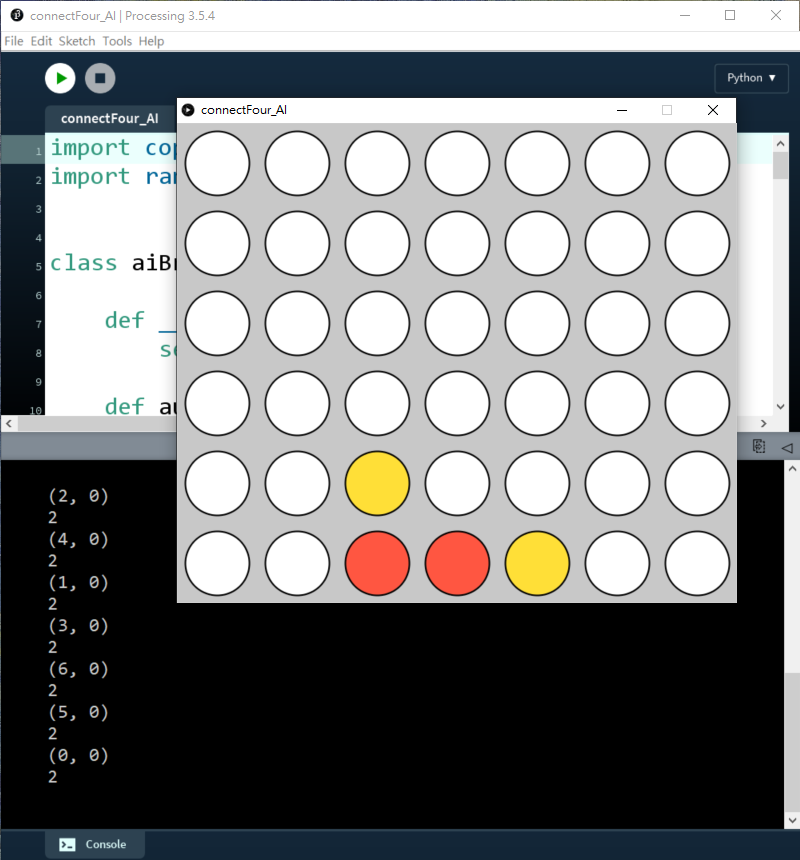
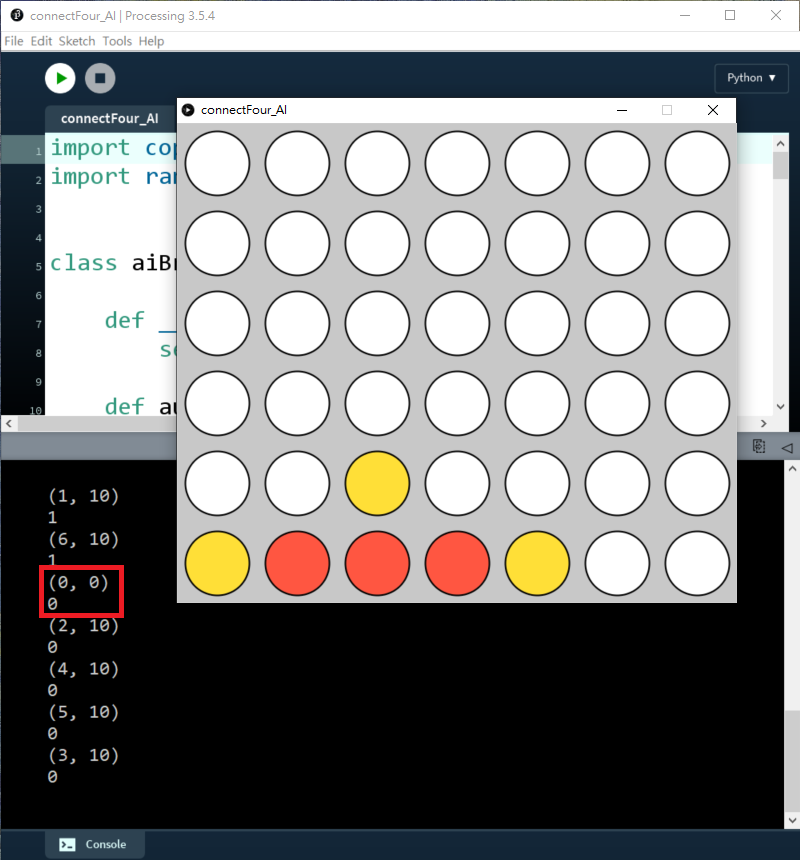
當depth=1,AI懂得去阻擋我贏
而且也懂得去贏:
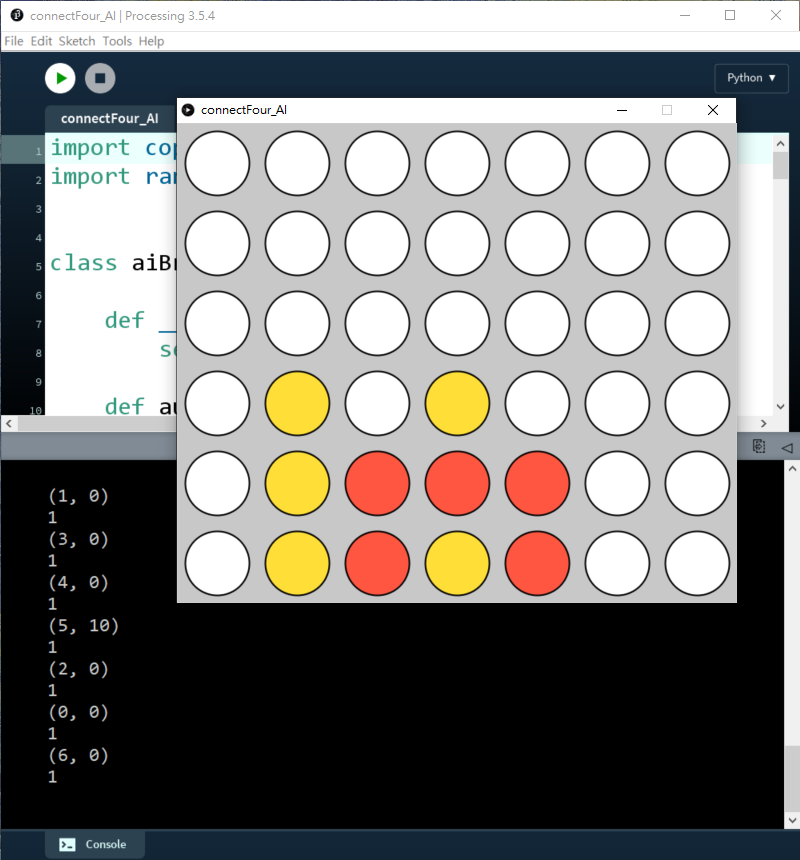
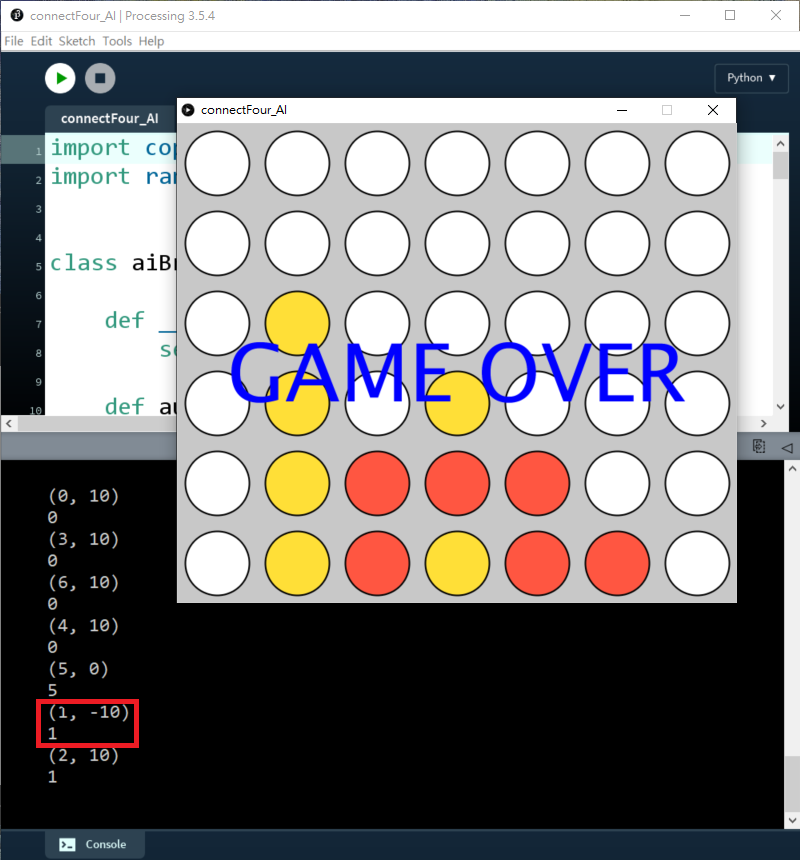
但反而depth=3或以上的話,效果反而一點也不明顯,好似突然變蠢了一樣。如下圖,當depth=3,明明只要下最右手邊的話就會即時贏,AI反而是阻擋我繼續下第三行而不去贏。
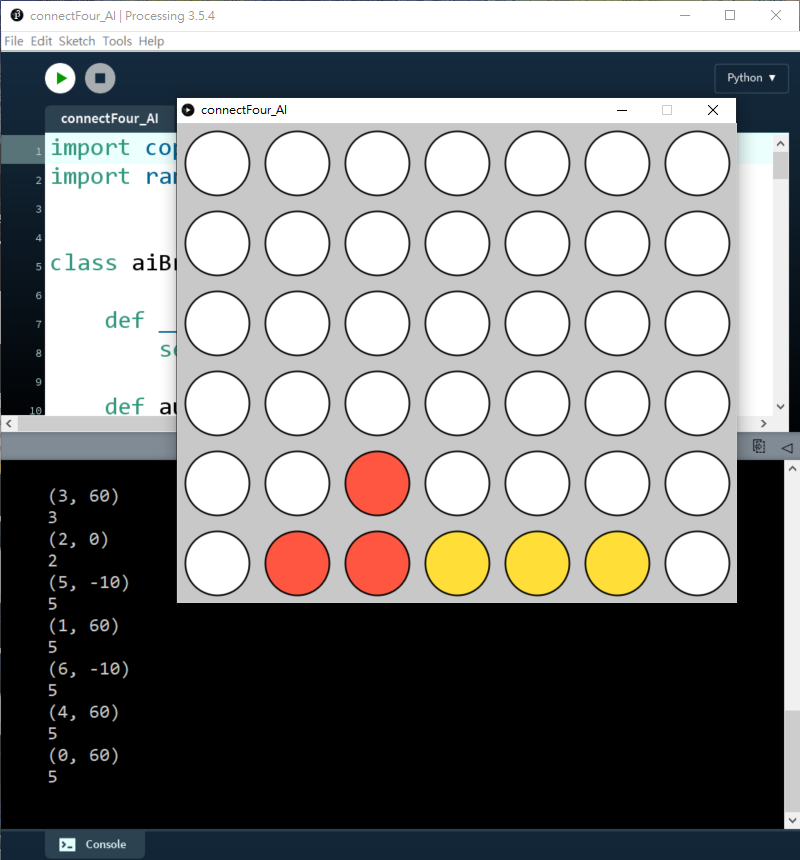
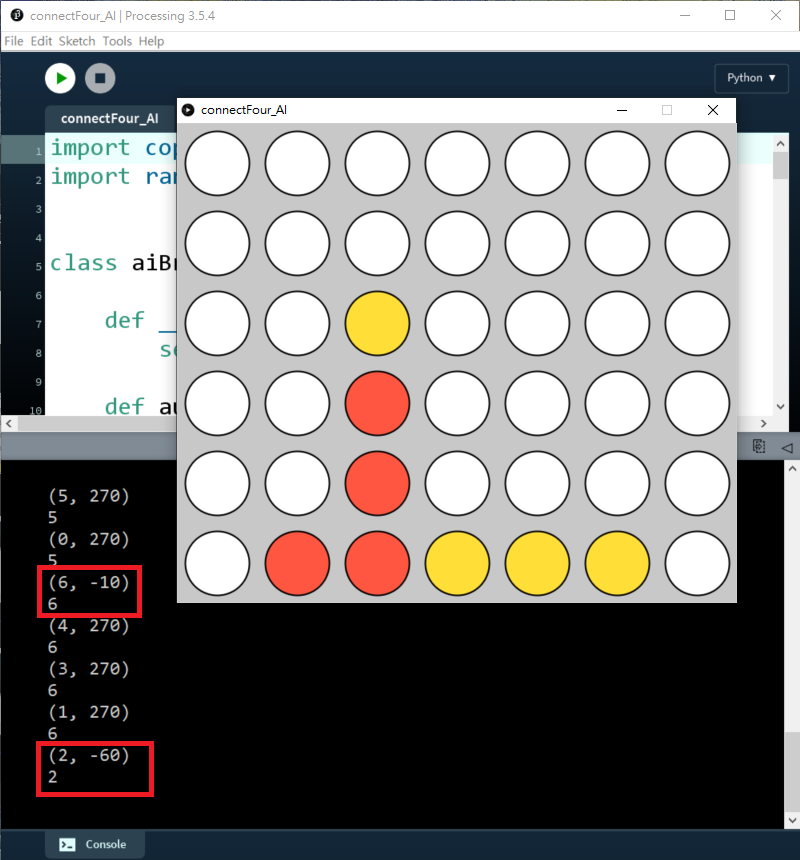
原因是:上述演算法沒有考慮深度的優先,如果下最右手邊(i=6),遊戲就會即時贏,所以分數只有-10,但如果下第三行(i=2),由於遊戲未完,演算法會繼續往下兩步(depth=3),所以會累加之後步的分數,所以反而會比即時贏的分數更少。
普通的minimax演算法,分數是會繼承tree diagram下層的分數,再分min或max,但這樣的方法,如果下一步有即時出現贏或即時輸,它能有效的防守或進攻,但它卻不懂得需要佈局、或走某一步對之後的局面更有利的情況,這是因為minimax演算法缺乏了深度的資訊。例如,minimax對於兩步之後能贏或四步之後才能贏的case,都會給出同等的分數。而我們上面的演算法改了用累加分數,則會累加之後步數,搜尋深度越深分數就會越大。
7. 令分數與depth成關係
import copy
import random


class aiBrain(object):

    def __init__(self, _gameBoard):
        self.gameBoard = _gameBoard

    def autoPlay(self):
        bestScore = float('inf')
        bestMove = random.randint(0, 5)  # the range is a, b+1

        # //fill the available colume to an list
        availableCol = []
        for j in range(7):
            if self.gameBoard.grids[0][j].value == '':
                availableCol.append(j)
        # shuffle the list
        random.shuffle(availableCol)

        for move in availableCol:
            possibleBoard = copy.deepcopy(self.gameBoard)
            possibleBoard.trigger(move)
            score = self.minimax(possibleBoard, 3, True)
            print(move, score)
            if (score < bestScore):
                bestScore = score
                bestMove = move
            print(bestMove)
        print('')
        self.gameBoard.trigger(bestMove)

    def score(self, _winner):
        if _winner == 'R':
            return 10
        elif _winner == 'Y':
            return -10
        elif _winner == 'O':
            return 0
        else:
            return 0

    def minimax(self, _gameBoard, _depth, _isMaximizing):
        winner = _gameBoard.checkWin()
        if winner != None or _depth == 0:
            return self.score(winner) * (10**_depth)

        if _isMaximizing:
            bestScore = 0
            # //fill the available colume to an list
            availableCol = []
            for j in range(7):
                if _gameBoard.grids[0][j].value == '':
                    availableCol.append(j)
            # shuffle the list
            random.shuffle(availableCol)

            for move in availableCol:
                possibleBoard = copy.deepcopy(_gameBoard)
                possibleBoard.trigger(move)
                score = self.minimax(possibleBoard, _depth - 1, False)
                bestScore += score
            return bestScore

        else:
            bestScore = 0
            # //fill the available colume to an list
            availableCol = []
            for j in range(7):
                if _gameBoard.grids[0][j].value == '':
                    availableCol.append(j)
            # shuffle the list
            random.shuffle(availableCol)

            for move in availableCol:
                possibleBoard = copy.deepcopy(_gameBoard)
                possibleBoard.trigger(move)
                score = self.minimax(possibleBoard, _depth - 1, True)
                bestScore += score
            return bestScore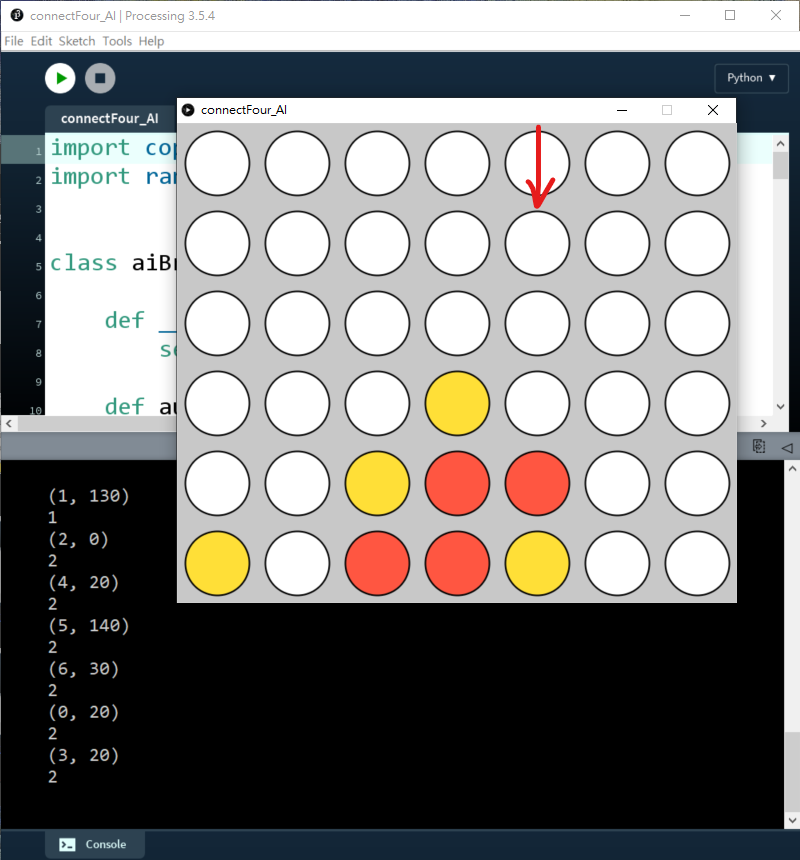
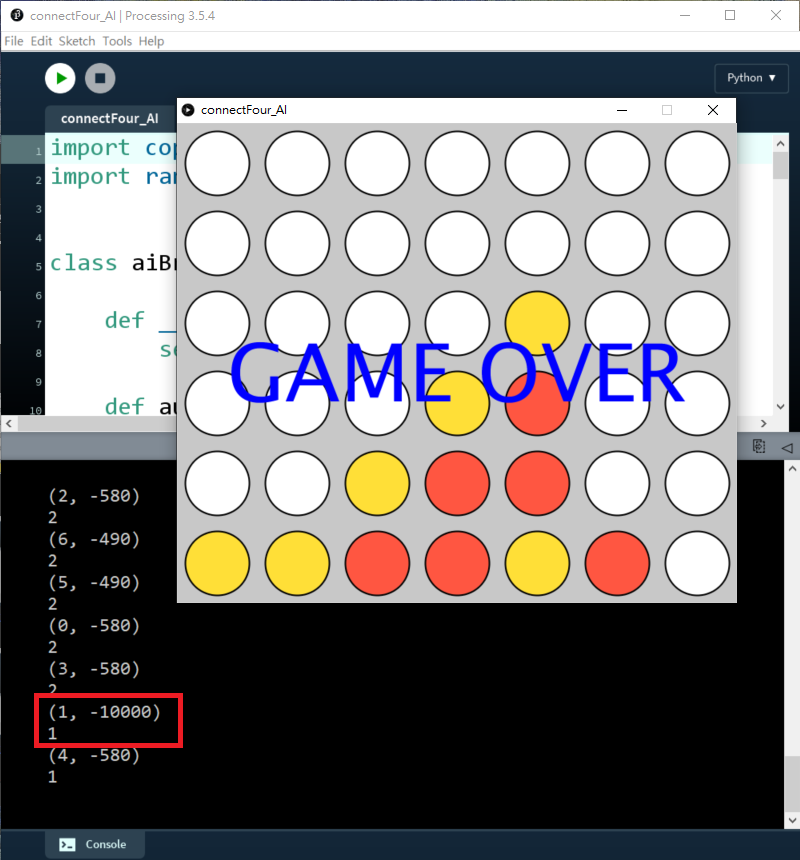
 def minimax(self, _gameBoard, _depth, _isMaximizing):
        winner = _gameBoard.checkWin()
        if winner != None or _depth == 0:
return self.score(winner) * (10**_depth)要改善這情況,方法是將輸出分數跟深度掛勾。將return的分數加了10的depth次方後,輸出分數就與深度成次方比,下一步會即時贏的話,depth=3就會是分,就會比兩步後再贏多出一個等數級。只要加入這個少少改變,AI就會變得非常厲害,當depth=2時,已經會考慮之後的3步去防守和佈局進攻,如果depth=3時,就會考慮到之後的4步去防守和進攻,已經可以防守和佈置兩頭蛇了。